Bob Carroll’s journey through 75 years of UT Martin history
Story by David Snow | Photos from UTM Special Collections and Archives and University Relations
Robert “Bob” Carroll (‘54) hasn’t just experienced UT Martin history; he is a notable figure in that history, as the university has been part of his life for decades. He was a member of the inaugural class inducted into the UTM Athletics Hall of Fame in 1983 and is a member of the Weakley County Sports Hall of Fame, Gibson County Athletics Hall of Fame, the Tennessee Sports Hall of Fame, and the University of Wyoming Academic Hall of Fame. He was an academic all-American quarterback at the University of Wyoming.
A standout quarterback for UT Junior College in the 1950 and 1952 seasons – which bracketed 18 months of Marine Corps Reserve service – he coached the UT Martin Branch team from 1957 to 1974, ranking second in school history with 83 wins and a victory in the school’s lone bowl appearance, a 25-8 win over West Chester State in the 1967 Tangerine Bowl in Orlando, Florida.
Carroll also taught history and is now an assistant professor emeritus of history at UTM. He authored “The University of Tennessee at Martin: The First One Hundred Years” for the university’s 100-year anniversary celebration in 2000.
The summer between Carroll’s first and second years on campus, in 1951, the college changed its name from UT Junior College to UT Martin Branch, becoming a four-year university. In 1967, it became the University of Tennessee at Martin.
Campus Scene talked with Carroll to discuss his life, his experiences and, of course, UT Martin.
Tell us about your personal history with UT Martin.
I came here as a student in 1950. It was UT Junior College then, and in 1951, it became UT Martin Branch. There were some people who didn’t want to make that change; you had some opposition. People rallied here in Weakley County and they rallied in the state legislature. We became a four-year college, but what was that four years in? Ag and home economics, and that was it. In 1951, we had 416 students, but by 1960, we had put in education studies, and within 10 years, we had over 1,100 students.
When did we become UT Martin?
That was in 1967, the same year we won the Tangerine Bowl against West Chester State out of Pennsylvania. (UT Martin was the Atlantic Coast College Division national champion that year with a 10-1 overall record under Carroll.)
What led you to write “The University of Tennessee at Martin: The First One Hundred Years”?
Well, there was no complete history of the university during that time. I felt challenged to write it because I was a history major. People would ask me, “Why don’t you write the history?” So, I accepted that challenge. I almost ran out of time because I had to have it for the year 2000, and then, I had to have it printed in Nashville.
I really enjoyed talking with the alumni. In fact, my father-in-law, Cliff Pritchett, was here in ’28, ’29 and ’30, and he went on and graduated from Knoxville. But I loved talking with the alumni; I’d go talk with them (for the book). The only problem was, I’d get two different versions of the same stories.
What differences and similarities have you noticed over the years?
It’s larger, but I’ve found that it is still a friendly campus, and it’s still strong academically. Back when it was a junior college, the demands were pretty strong. You didn’t come here and be able to just lean back and kind of coast through because it was a tough, tough junior college.
How did you come to be the coach?
When I was at the University of Wyoming (where Carroll went after graduating from UT Martin Branch), I had planned to go to medical school, and I needed organic chemistry and comparative anatomy. I came back after graduating Wyoming, going to take those courses, and I helped coach. (Then-Chancellor) Paul Meek called me in and offered me the job, and I said, “Well, I don’t really have any money to go to medical school, anyway,” so I needed to work to get some.
James C. Henson was the head coach just before me, and he did a good job. He was also the head of physical education, and truly, I was the last coach to be half-coach and half-history teacher after that. I have no regrets about not going to medical school now.
You met your future wife when you came back to campus as the football coach. How did that happen?
When I came here (to coach in 1956), I was single, and lo and behold, there was a good-looking cheerleader. She was on the tennis team, and she was a campus beauty – Kay Pritchett (’57). So, I went to see Paul Meek, and that’s when I asked him, “Can I date a student?” He said, “Yeah, I know both of you. Go ahead.” So, two years later, we got married.
I wanted to mention her because she died Aug. 13 from Alzheimer’s. She was a great wife, great mother and, really, a great friend.
You have been part of UT Martin’s 50th, 100th, and now 125th celebrations. How does it feel to have been connected to the university through so many milestones?
It really feels good. The thing about it is: You have to have a love for the campus, and the first thing that happens is you think back about how it was and about the good old days. You look back and you had hardships, but you think back about all the happy memories you had and everything from the campus.
I enjoyed teaching history for the simple reason that I liked being around the students. I enjoyed it – I did. Things were kind of hectic at times, but I really enjoyed it.
Talk about some of the leaders on campus that you knew.
Paul Meek was good leader that you could count on. When he told you something, that’s the way it was – he was just a good guy. Margaret Perry (’61) was very good because she was very sincere, and if she told you something, you could count on it.
Let’s talk about your football career at Milan High School.
Well, what happened is I went out for football as a freshman, and I’d never even seen a football game. When I went out, they asked the guy in front of me what position he wanted, and he said, “Halfback.” I didn’t know what a halfback was, but that was all I knew to say. My freshman year, I got in a few games, and I started as a sophomore. Then, I was co-captain my senior year, and we went 8-3. We had some good athletes my senior year.
Do you still enjoy homecoming?
They are special to me. Now, when I was in charge of Alumni Affairs, they involved a lot of work, but I enjoy going to the Homecoming games now because I have no pressure on me. Since 1956, I’ve only missed one, and that was in 1997. I went to Wyoming. They were having a reunion, so I had no choice. The four of us went together. I picked them up and I had the car, so we took out and drove out there. We had a big time doing that!
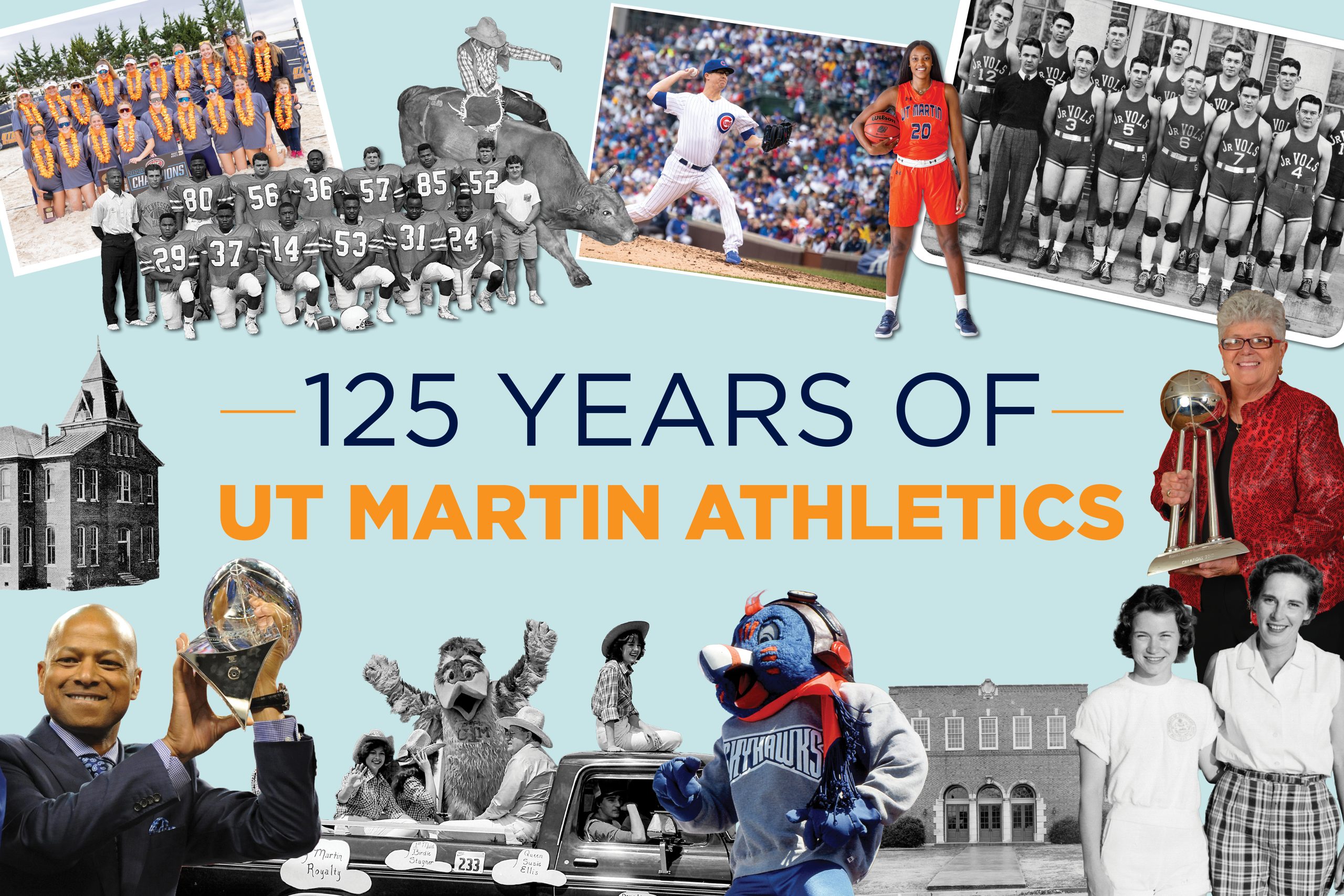
Bob Carroll literally wrote the book on the history of UT Martin, which is celebrating its 125th anniversary as an educational institution. UT Martin kicked off its 125th anniversary celebration on Oct. 10, and will have several events throughout 2026.
For more information about the 125th anniversary celebration events or to purchase commemorative items, visit alumni.utm.edu/celebration.