Story by Holly Anne Seng | Photos by Molly Hamilton Photography
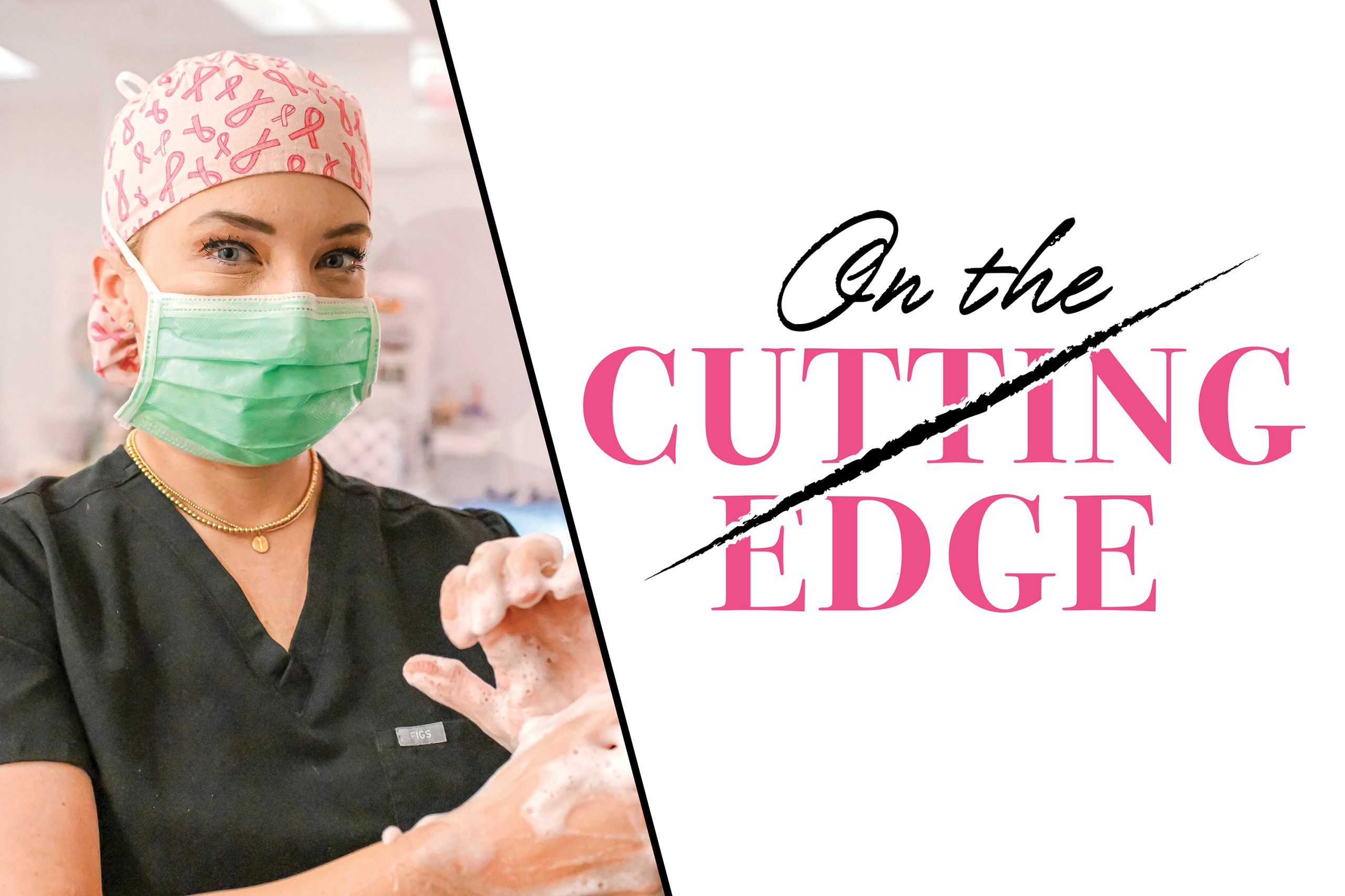
In April 2025, Dr. Katelin Turner Holmes (’11) became the first surgeon in the United States to perform a minimally invasive nipple-sparing mastectomy procedure that was approved by the Food and Drug Administration. The technique allows eligible breast cancer patients to undergo a mastectomy through a smaller incision positioned at the side of the body. For Holmes, a 2011 UT Martin alumna and breast surgical oncologist, the significance of the procedure extends well beyond the operating room.
“When you look at someone facing forward (after this procedure), you wouldn’t know that they’ve had a mastectomy,” Holmes said. “I feel like that is a gift to be able to give someone.”
Historically, mastectomies have been highly invasive procedures that require removing breast tissue through larger incisions that can leave significant scarring and permanently alter its appearance and sensation. While the primary goal has always been effective cancer treatment, the physical changes left behind can carry emotional and psychological effects long after the surgery is complete. Finding a way to lessen that lasting impact is an important part of Holmes’ method of caring for the whole patient.
Some of her patients have retained sensation following the minimally invasive procedure, an outcome Holmes said can result from placing the incision farther away from the sensory nerves affected by traditional approaches. Those details matter because she thinks about breast cancer surgery not only in terms of removing disease, but also in terms of the life a patient will lead afterward.
“It might take me a few hours in surgery, but that’s a lifetime that they’re going to live with,” Holmes noted.
That perspective is central to Holmes’ approach to medicine. The success of a procedure matters, but so do the things that remain long after surgery: scars, sensation, confidence, and the emotional impact a diagnosis can have on how a woman sees her own body.
For Holmes, innovation is more than being able to say she was first. It’s about asking whether patients can be offered something better.
“I never wanted to stop at face value and offer people what was standard,” she said. “We need to talk about what’s possible too.”
A CALLING TAKES SHAPE
Although she often moved throughout childhood because of her father’s military service, Holmes considers Union City home. No matter the address, medicine remained a constant. As early as she can remember, she told her mother she wanted to become a surgeon.
“The only way I know how to describe it is a calling,” she said. “I just knew my whole life I was going to be a physician.”
A cheerleading accident in high school made that calling more personal. Holmes suffered a spinal cord injury and ultimately made a full recovery, but the experience exposed her to medicine from the patient’s perspective and strengthened her desire to give others a better health-care experience.
During her senior year of high school, she began working for a surgeon in Union City after meeting him through a community health care exposure program. Holmes worked as a medical assistant and receptionist and continued the job throughout her years at UT Martin, eventually getting opportunities to scrub in on surgeries.
“I loved general surgery, but I loved specifically the breast cancer aspect of that practice,” she said. “I wanted to be a breast cancer specialist, based on my experience there.”
UT Martin provided Holmes the opportunity to stay close to her family and continue working in the surgeon’s office while preparing for medical school. The university also carried a family connection: Her aunt, an obstetrician-gynecologist who practiced in Tuscaloosa, Alabama, was a UT Martin graduate and an important influence on Holmes’ decision to pursue medicine.
” I just knew my whole life I was going to be a physician.”
Dr. Katelin Turner Holmes
At UT Martin, Holmes joined the University Scholars Program, where she also met fellow student Chad Holmes (’11). The two were friends during college before reconnecting and beginning to date while Holmes was in medical school. Both graduated in 2011 and later married.
When Holmes reflects on her undergraduate experience, though, she often returns to the professors who knew her personally and encouraged her ambitions.
“You’re a name there, too,” she said. “You’re not just a random student in someone’s class.”
She remembers conducting research with Dr. Lionel Crews through the University Scholars Program, an experience that strengthened her medical school application. She remembers Dr. James Smart’s genuine excitement when she received an interview for medical school. Courses in genetics and anatomy taught by the late Dr. John Collins and Dr. Ann Gathers gave her knowledge she now uses routinely while counseling and operating on breast cancer patients.
“There were times where I was like, ‘I don’t know if I’m going to do this. I don’t know if I’m going to get in,’” Holmes said. “I had professors who really believed in me.”
RETHINKING WHAT’S POSSIBLE
In medical school, Holmes trained as a doctor of osteopathic medicine. The osteopathic approach’s emphasis on caring for the whole patient — body, mind, and spirit — aligned closely with the kind of physician Holmes wanted to become.
“Breast cancer is extremely personal,” she said. “It’s not simply just me operating on them.”
Treatment involves more than removing cancer. Holmes considers where scars will be placed, reconstruction options, and the emotional effects of a diagnosis and surgery. Care often requires close collaboration among surgeons, oncologists, radiation oncologists, and other specialists.
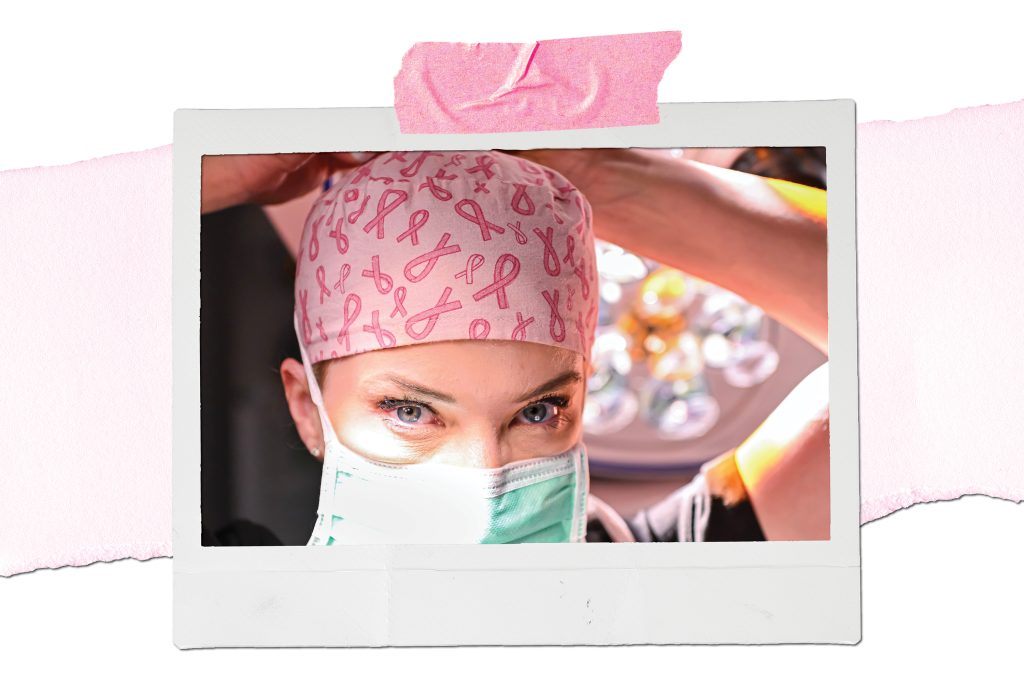
For Holmes, it means seeing “someone for who they are, not just a disease.”
That thinking eventually contributed to Holmes’ interest in a minimally invasive approach to nipple-sparing mastectomy. Traditional nipple-sparing mastectomies can provide strong cosmetic results, but Holmes found the incision placement challenging because of limited visibility during surgery. Having trained in an era of robotic and laparoscopic procedures, she began wondering whether similar technology could be applied to breast surgery.
“If I could only get a laparoscopic camera pointed in here, I think I could almost do this operation laparoscopically,” Holmes recalled thinking.
“People deserve great health care, no matter where they live.”
Dr. Katelin Turner Holmes
A representative from the company that manufactures the surgical access device overheard a discussion on the topic and told Holmes about its approval for use in breast surgery. Holmes traveled to Amsterdam to train with surgeons experienced in the technique before returning to her practice in Fairhope, Alabama, and performing the procedure on an appropriate patient.
The first surgery was successful. Holmes emphasized that while the approach is not suitable for every mastectomy patient, for those who qualify, it can result in a much smaller scar positioned toward the side of the body. For Holmes, continuing to improve breast cancer surgery is part of recognizing the long-term effects treatment can have on women.
BRINGING SPECIALIZED CARE CLOSER TO HOME
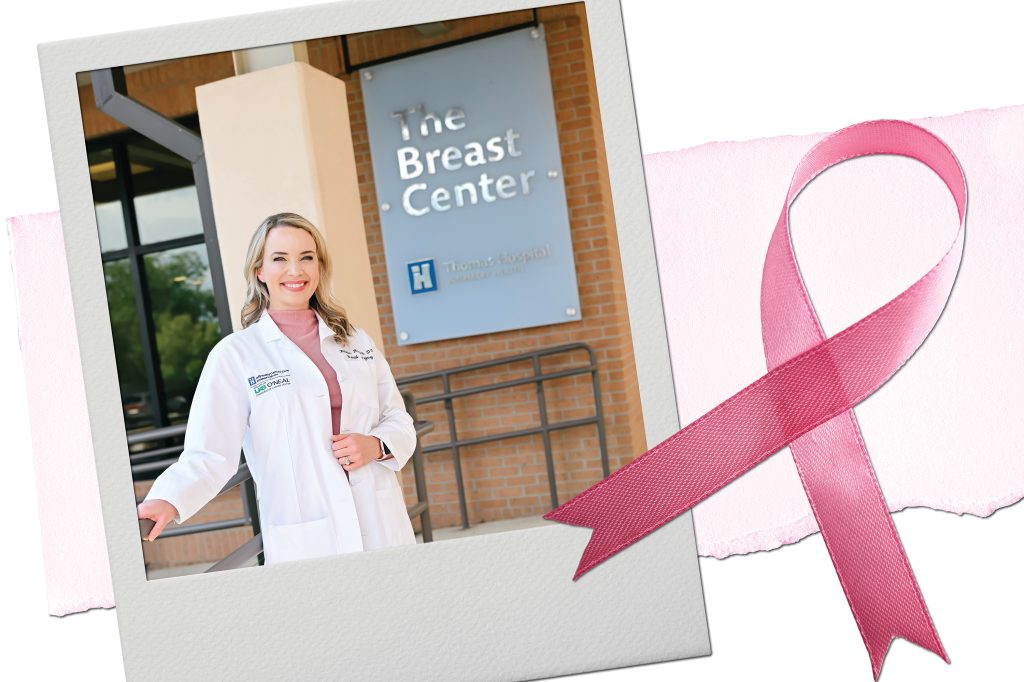
Today, Holmes practices through an affiliation between the University of Alabama at Birmingham’s O’Neal Comprehensive Cancer Center and Mobile Infirmary Health and serves as a clinical assistant professor at UAB.
The location fulfills another goal she formed while growing up in West Tennessee. Holmes remembers how often receiving specialized care meant traveling to Memphis or Nashville. Following her spinal cord injury, her own family regularly made trips to Memphis for treatment. She knew she eventually wanted to bring specialized care to a community where patients might otherwise have to leave home to receive it.
“People deserve great health care, no matter where they live,” she said.
She is the only fellowship-trained breast surgeon in Baldwin County. Yet, when asked about the accomplishment that makes her most proud, Holmes does not point first to a medical milestone. Instead, she points to her family.
Holmes and her husband, Chad, are parents to daughters Georgia, 6, and Charlotte, 3. Growing up, Holmes did not know female surgeons, much less women demonstrating that it was possible to combine motherhood with a demanding surgical career. Now, her daughters get to see that example firsthand, along with the sacrifices that sometimes accompany a career centered on serving others.
“I think it has been a good example of teaching them to think about others and serving,” Holmes said.
More than 15 years after her own time on campus, Holmes still describes UT Martin as home, the place where she built lifelong friendships, met her future husband, and found professors who gave her the preparation and confidence to pursue a demanding career. Although her operating room is now hundreds of miles from Martin, Holmes sees a connection between what she learned there and the career she has built.
“I felt like I was a part of something where I mattered,” she said. “It taught me a lot about building relationships, investing in people, striving for something that was bigger than yourself, and remembering where you came from.”