Story by Bud Grimes | Photos from Nathan Morgan
Restoring something to its original state can be a daunting challenge. This includes the restoration of land and streams to how they once were long ago. For Dr. Tom Blanchard, UT Martin professor of biological sciences, other scientists and UT Martin students, restoration projects create opportunities to benefit land, streams, wildlife, and people. Their work with the West Tennessee River Basin Authority (WTRBA) at DeLoach Creek in northern Madison County aims to restore fallow fields to their natural state, and among other benefits, provide a natural habitat for people to someday enjoy.
Madison County is the 24th-largest landmass county in Tennessee, and population growth and development are moving northward toward the Three Way community where Middle Fork Bottoms State Park, Tennessee’s newest state park, is situated on the north side of Forked Deer River near the town. DeLoach Creek is located on the south side of the river, where 300 acres of former agricultural land are prone to flooding. The state purchased the land, and the river basin authority is working to restore the stream’s natural path and reconnect the floodplain.
One problem is that in its current state, nutrient-rich runoff flows directly into the river during flooding, which eventually finds its way to the Mississippi River and ultimately the Gulf of Mexico. The restoration project will help to address this by restoring native ecosystem services that reduce excess nutrients to waterways.
The Process and the Participants
UT Martin and the WTRBA are contracted to do different aspects of the work. Blanchard was involved in UTM’s first contract in 2011, and three more contracts have followed. Dr. Kayla Key (’12), a former student of Blanchard’s from Beech Bluff who earned her doctorate at Tennessee Tech, now works with the WTRBA and asked the university for additional assistance. Faculty members Drs. Jennifer Greenwood and Lisa Krueger joined Blanchard to lend their expertise on the biological aspect of the project.
“What we are doing is we are monitoring the biological response to restoration in that localized area,” Blanchard said. “There’s also some more localized problems, with stream channelization and its effect on the connectivity between the stream and the landscape on either side.”
“One of the things that happens when the streams are channelized is they’re also leveed, which means the stream water never gets out of that unless it’s an extreme flooding event, which is a problem by itself, too.”
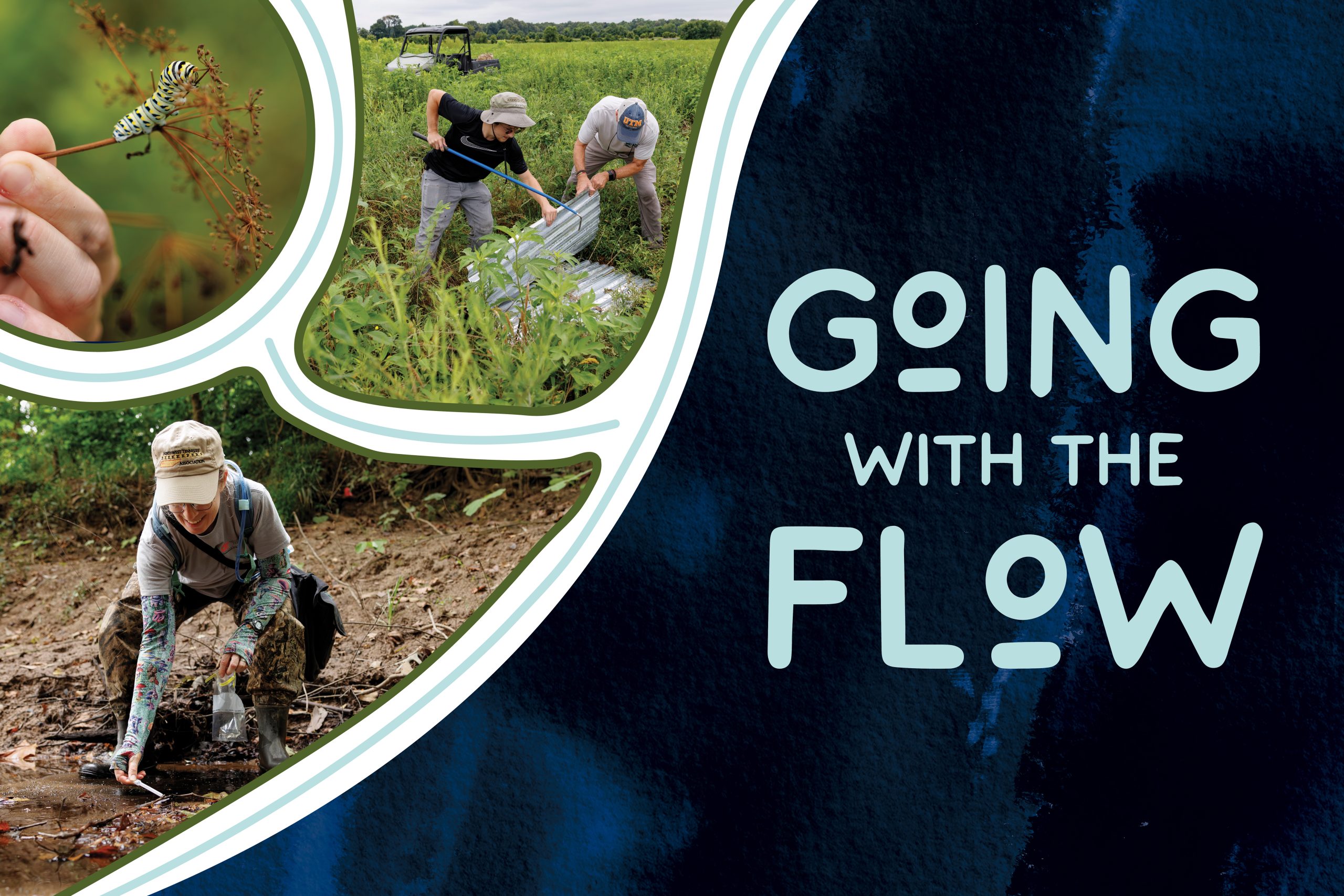
Blanchard, whose academic specialties include herpetology and ichthyology, is studying fish, aquatic bugs, amphibians, and reptiles. Greenwood and Krueger will be examining algae in the stream and terrestrial plants, respectively. As faculty members, they value the research exposure for students.
“The idea is to monitor that area for the long term to see what the response is in the vegetation, or for me, it’s the fish and the aquatic bugs, and for Dr. Greenwood, it’s the algae,” he said.
“Hopefully when the habitat is restored, then you would expect an increase in biological diversity of all those organisms.”
“There are people that like to see things, that like to see a nighthawk or like to see a spotted salamander, or like to see a black racer, just wildlife viewing,” he said. “When I go out, I like to see those things, and there’s lots of other people that do that, too, and so bringing back native wildlife is important for that.”
Partnering for Change
Blanchard organized an early August visit to the DeLoach Creek site that included river basin authority and university representatives involved in the project. Two all-terrain vehicles traveled through heavy vegetation that was once cropland to where the creek meets the Middle Fork of the Forked Deer River. Outside of flooding, the creek’s depth generally varies from waist-deep water to a series of shallow pools and was low enough this day to allow a short trek up the channel.
Kris Gordon (’10) is an engineering graduate from Jackson who works with the WTRBA. Among other conservation duties, the river basin authority is tasked with maintaining the flow and function of West Tennessee streams. The WTRBA is under the Tennessee Department of Environment and Conservation.
“So, we’re looking at taking DeLoach Creek and meandering it, increasing its length, adding some flood benefits, and hopefully some wetland benefits on this property that used to be all row crop,” Gordon explained. “It’s been out of row crop for several years and just hoping to restore some of its flood function as well as increase floodplain for when the rivers get up. It’ll help take some of that flood peak off.”
Returning the stream to its original state is an engineering task, and duplicating what was in place decades ago won’t be perfect, but the changes made will make a positive difference.
“It’s kind of hard to find old maps where the old meanders are,” Gordon said. “But that is our intent, to get it back to a meandered stream, instead of being straight, to mimic natural flow.”
Noah Hickman is assisting Blanchard in locating and sampling reptiles and amphibians to determine the site’s diversity. He’s also working with Krueger to study plant composition, while Rodriguez assists faculty members with project work, but is also conducting a personal research project comparing upstream and downstream water quality.
While gaining valuable research experience, both also will gather data to present at the Association of Southeastern Biologists conference in spring 2026 in Mobile, Alabama.
“I want to get into this line of work whenever I graduate,” Rodriguez said. “I really have a preference for habitat management, especially in aquatic or wetland habitats.”
“It’s a beautiful site, and it’s a great start to a career,” Hickman added. “It’s highly motivating to want to do more work like this.”
Dr. Melody Sain (’12), a Humboldt native and also one of Blanchard’s former students, recently completed post-doc work at Bucknell University in Pennsylvania and is an environmental consultant-level two in her new position with the WTRBA.
As a botanist and greenhouse manager, she will propagate plants, possibly including river cane, in the restored site. Plants for DeLoach Creek will come from greenhouses located in nearby Three Way. Sain will also help introduce mussels with their natural filtering ability and host fish populations in rivers at this and other sites.
“I kind of like thinking of it as self-sustaining wetlands where you have mussels, you have fish, you have plants that are cleaning your water, filtering and helping out (with water quality),” Sain said.
Drew Barclay (’25) of South Fulton earned a degree in organismal biology and was deciding his next steps when Blanchard told him of a new partner position with the Tennessee Wildlife Resources Agency and WTRBA. The partner position would work with mussel propagation through the river basin authority and introduce the mollusks to rivers to improve water quality.
Originally focused on a marine biology career, Barclay has a new appreciation for DeLoach Creek, the Forked Deer River, and other streams in the region. During the channel walk, Blanchard and Barclay didn’t hesitate to do some noodling for a baby catfish in a small creek pool.
Water quality is important, and although DeLoach Creek is too shallow to support a mussel population, Barclay sees a bigger opportunity just beyond the creek bank.
“The Forked Deer River would be great for mussel relocation. I’m sure it’s real healthy as it is, but the more mussels we can get out in the environment and get them working for a long period of time and growing and filtering the water, the better,” Barclay said.
Greenwood, a professor of biological sciences, has worked with the restoration project from its beginning. Her role is to determine how stream restoration changes the diatom community, which she expects to thrive with channelization reduction.
Diatoms are a type of aquatic microscopic algae that have glass cell walls and are colorful to view under a microscope. They are an important food source that supports fish populations and other animals, and they provide half the oxygen we breathe.
“Right now, there’s a lot of sediment in the stream that’s very shifty, and so every time it rains pretty hard, it’s going to move that around, and it makes it hard for the diatoms to grow,” she said. “So, if we also get more stuff — we’d call it biomass — just more growth, that would probably mean that the flow is a little more stable, and so we could get more growth of diatoms.”
Work to Be Done
Stream restoration is a complex task that requires many kinds of expertise. During a final stop while exiting the site, Blanchard’s herpetology skills came into play when he caught a four-foot rat snake that remained calm through the experience and seemed to appreciate the group’s attention. Wildlife large and small, including this rat snake that calls the area home, should benefit from the project’s hoped-for success.
Restoring DeLoach Creek closer to its original state is a challenge since climate and other conditions have changed over time. However, Tom Blanchard and those around him believe that what they’re doing makes a positive difference. To that end, DeLoach Creek and other West Tennessee sites stand to flourish where successful stream restoration occurs.